
If you are searching for how to prepare for the OMSB exam, you are probably a doctor, dentist, nurse, pharmacist or allied health professional planning a career in the Sultanate of Oman. The Oman Medical Specialty Board’s occupational classification examinations — the “OE” exams — are the gateway to employment in Omani healthcare institutions, and they reward structured, blueprint-driven preparation far more than last-minute cramming.
This guide explains exactly what the OMSB exam looks like in 2026, how its official blueprints work, ten proven study tips, a 6-week plan, a sample study day, the mistakes to avoid and answers to the ten questions candidates ask most often.
- Confirm your exact OE exam code (for example OEGP, OEN or OEP) before you start.
- Most OE exams are 100 single-best-answer MCQs in 2 h 30 min; OEGP and OMRSE are 150 MCQs in 2 h 45 min.
- Pass marks range from 50% to 65% depending on the exam.
- Use the official blueprint to weight your study time — domains can vary by about ±5%.
- Plan 4–8 weeks of daily practice, finishing with timed mixed sets.
What is the OMSB exam?
The Oman Medical Specialty Board (OMSB) was established by Royal Decree 31/2006. Its Occupational Classification Testing Section runs computer-based examinations that confirm healthcare professionals have the competencies to practise safely, and the results are used as eligibility criteria for employment in Oman. The exams are scheduled and delivered by Pearson VUE, at the OMSB National Test Center in Muscat or at Pearson VUE test centres worldwide.
Every question is a single-best-answer multiple-choice question, usually built around a short clinical or professional scenario. The format depends on your exam:
| Exam | Questions | Time | Pass mark |
|---|---|---|---|
| OEGP – General Practitioners | 150 | 2 h 45 min | 60% |
| OMRSE – Residency selection | 150 | 2 h 45 min | 60% |
| Specialist OE exams (e.g. OEIM, OEOG) | 100 | 2 h 30 min | 65% |
| OEGD – General Dentists | 100 | 2 h 30 min | 65% |
| OEN – Nursing (Bachelor) | 100 | 2 h 30 min | 60% |
| OEP – Pharmacists | 100 | 2 h 30 min | 60% |
| OEMLS, OEPH, OEDIET, OEAP | 100 | 2 h 30 min | 55% |
| OEN-Diploma – Nursing (Diploma) | 100 | 2 h 30 min | 50% |
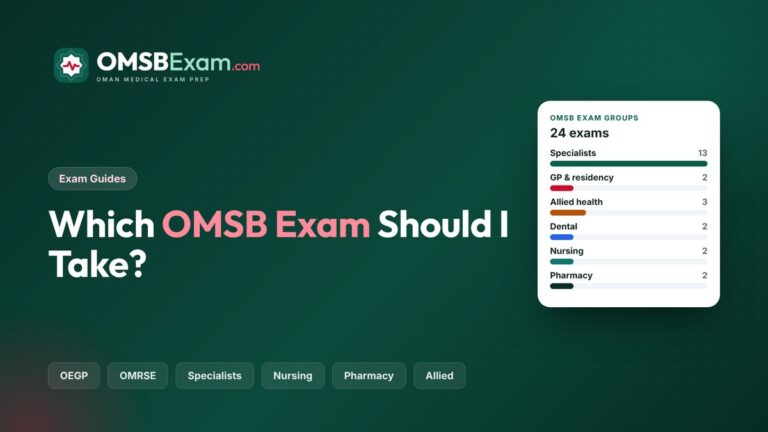
Not sure which code applies to you? Read Which OMSB Exam Should I Take? or compare every exam side by side on our OMSB exams page.
How to prepare for the OMSB exam: 10 proven study tips
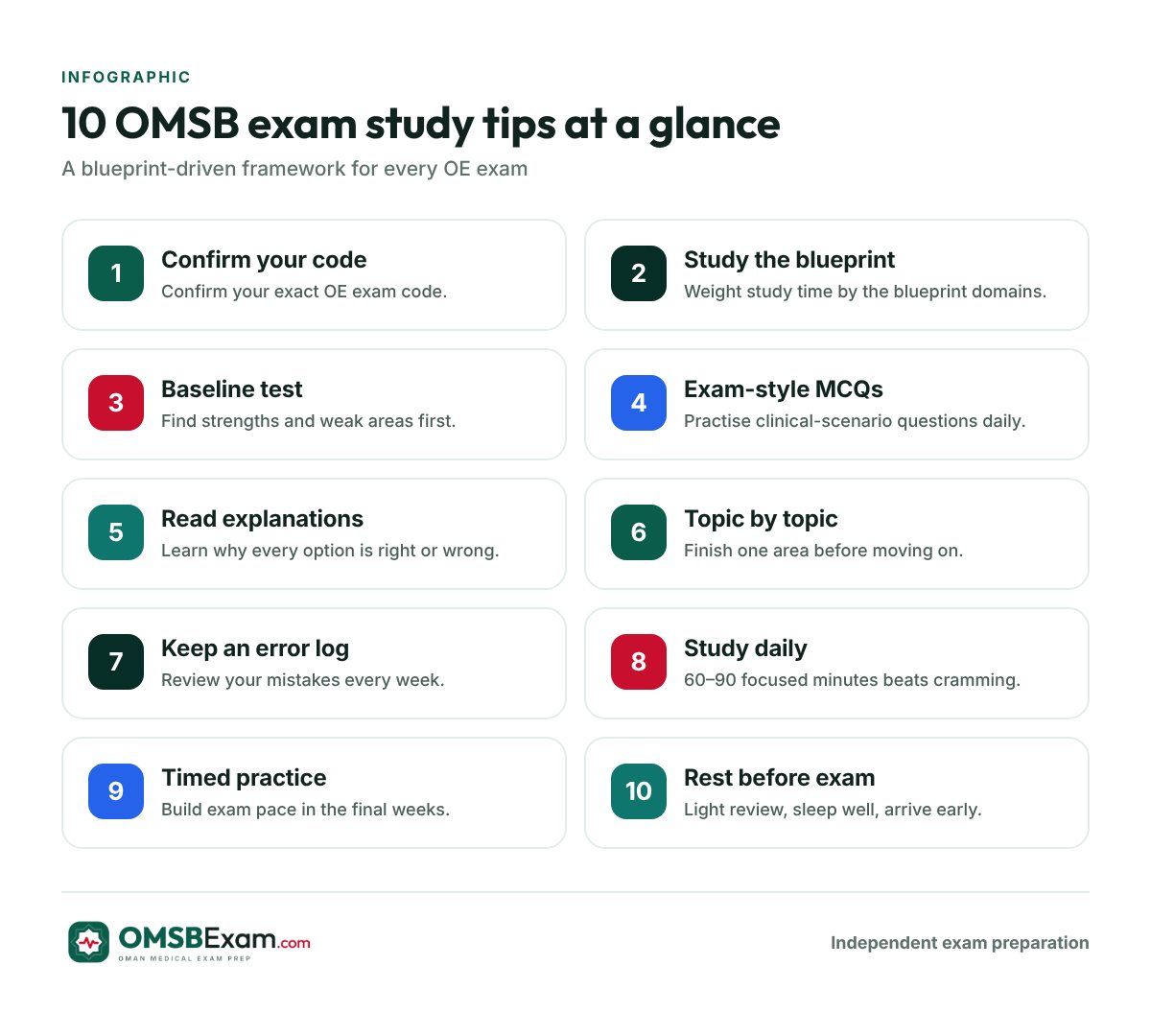
1. Confirm your exam code first
OMSB sets separate exams for general practitioners, 13 physician specialties, general dentists, orthodontists, nurses (bachelor and diploma), pharmacists, assistant pharmacists, medical laboratory scientists, physiotherapists and dietitians. Studying for the wrong exam is the most expensive mistake you can make, so confirm your code on the OMSB e-portal or with your employer before you invest weeks of effort.
2. Download and study the official blueprint
Every OE exam has a published blueprint that lists its domains and the percentage of questions from each. In the OEGP, for example, Medicine makes up 39% of the exam, Surgery 18%, Women’s Health 13%, Emergency 12%, Public/Community Health 11% and Child Health 7%. Your study time should follow the same weighting. We show every blueprint domain by domain on each exam page.
3. Take a baseline test
Before revising, answer a mixed set of questions across all domains. Your baseline score tells you which high-weight domains need the most work — a 10-point gain in a 39% domain is worth far more than perfecting a 2% one.
4. Practise single-best-answer MCQs daily
The OMSB exam tests decision-making: choosing the most appropriate diagnosis, investigation or management step. Regular practice with scenario-based MCQs trains you to spot the key clue in each stem and to pick the best option rather than one that is merely “true”.
5. Read every explanation
Read the explanation for every question, including the ones you got right. Understanding why each distractor is wrong is what lets you handle unfamiliar questions on exam day.
6. Study domain by domain, then mix
Work through one blueprint domain at a time, then switch to mixed sets once every domain is covered. Mixed practice mirrors the real exam, where topics change from one question to the next.
7. Keep an error log
Write down every concept you get wrong with a one-line correction, grouped by blueprint domain. Review it weekly — it quickly becomes your most valuable revision resource.
8. Know Omani and international guidelines
The booklets list recommended references for each exam (for example standard textbooks and international guidelines). Focus on current first-line management, patient safety, ethics and professionalism — these appear across almost every OE blueprint.
9. Train your pace
With 100 questions in 150 minutes you have about 90 seconds per question; with 150 questions in 165 minutes you have about 66 seconds. In the final two weeks, practise timed sets at that pace and learn to flag and move on.
10. Prepare for test day
Confirm your Pearson VUE appointment, arrive early with the valid ID that matches your registration name exactly, and use the last two days for light review of your error log. Our step-by-step registration guide covers booking, rescheduling and test-day rules.
Divide your study hours by blueprint weight. If you have 40 hours for the OEGP, that is roughly 16 hours of Medicine, 7 of Surgery, 5 each of Women’s Health and Emergency, 4 of Public Health and 3 of Child Health.
A 6-week OMSB study plan
Take a mixed baseline test, map your scores to the blueprint and fix your daily study time.
Cover the largest blueprint domains first with domain-wise MCQs and full explanations.
Finish the smaller domains, then repeat incorrect questions and review your error log.
Full-length timed mixed sets at exam pace. Light review in the last two days, then rest.
A sample study day
| Time | Activity | Goal |
|---|---|---|
| 10 min | Review yesterday’s error log | Reinforce weak points |
| 40 min | 25–30 blueprint-weighted MCQs | Apply knowledge to scenarios |
| 25 min | Read explanations and make notes | Understand the reasoning |
| 10 min | Update your error log by domain | Capture what to revisit |
Common mistakes to avoid
- Confirm your exam code and booklet
- Weight study time by the blueprint
- Practise every day, even briefly
- Simulate exam timing in the final weeks
- Match your ID name to your registration
- Spend days on 2% domains
- Rely only on reading textbooks
- Ignore ethics and patient safety
- Learn brand-new topics the night before
- Leave booking until seats are gone
Frequently asked questions
How long should I study for the OMSB exam?
Most candidates prepare for 4–8 weeks at 60–90 minutes a day. Plan for the longer end if you have been away from clinical practice or are sitting a broad exam such as the OEGP or OMRSE.
How many questions are in the OMSB exam?
Most OE exams have 100 single-best-answer MCQs in 2 hours 30 minutes. The OEGP and OMRSE have 150 MCQs in 2 hours 45 minutes.
What is the OMSB passing score?
It depends on the exam: 65% for specialists, OEGD and OEORDNT; 60% for OEGP, OMRSE, OEN and OEP; 55% for OEAP, OEMLS, OEPH and OEDIET; and 50% for OEN-Diploma.
Who delivers the OMSB exam?
Pearson VUE schedules and delivers the exams, at the OMSB National Test Center in Muscat or at Pearson VUE test centres worldwide.
How much does the OMSB exam cost?
According to the 2025–2026 booklets the fee is 220 USD for physicians and dentists, 200 USD for nursing, pharmacy and allied health, and 130 USD for the OMRSE. Always check the current fee when booking.
When will I get my result?
OMSB states results are usually emailed within about 24 hours of the exam.
Does the blueprint tell me exactly how many questions per domain?
It gives the percentage of the exam drawn from each domain. OMSB notes the actual number may vary by about ±5%, so use it as a guide to priorities.
Should I use textbooks or a question bank?
Use both, but prioritise exam-style questions with explanations, and use the booklet’s recommended references to fill specific gaps.
What should I do in the week before the exam?
Do timed mixed sets early in the week, then light review of your error log in the final two days. Confirm your appointment, test-centre address and ID.
What happens after I pass?
Your result supports your employment and licensing process in Oman. Our OMSB exam guide explains the steps that follow.
Conclusion
Preparing for the OMSB exam comes down to three things: knowing your exact exam, studying by the official blueprint and practising exam-style MCQs every day. Follow the 6-week plan, keep an error log and finish with timed practice, and you will walk into the test centre confident.
- OMSB Occupational Classification Testing Section — candidate booklets and blueprints
- Pearson VUE – OMSB — scheduling and test centres
- Always confirm exam details with OMSB before booking.
Pass your OMSB exam with confidence
Join healthcare professionals preparing with exam-style questions built for the OMSB Oman exam.
- Exam-style MCQs for 24 OMSB exams
- Detailed explanations for every question
- Topic-wise practice on mobile, tablet and desktop
- Instant access after payment